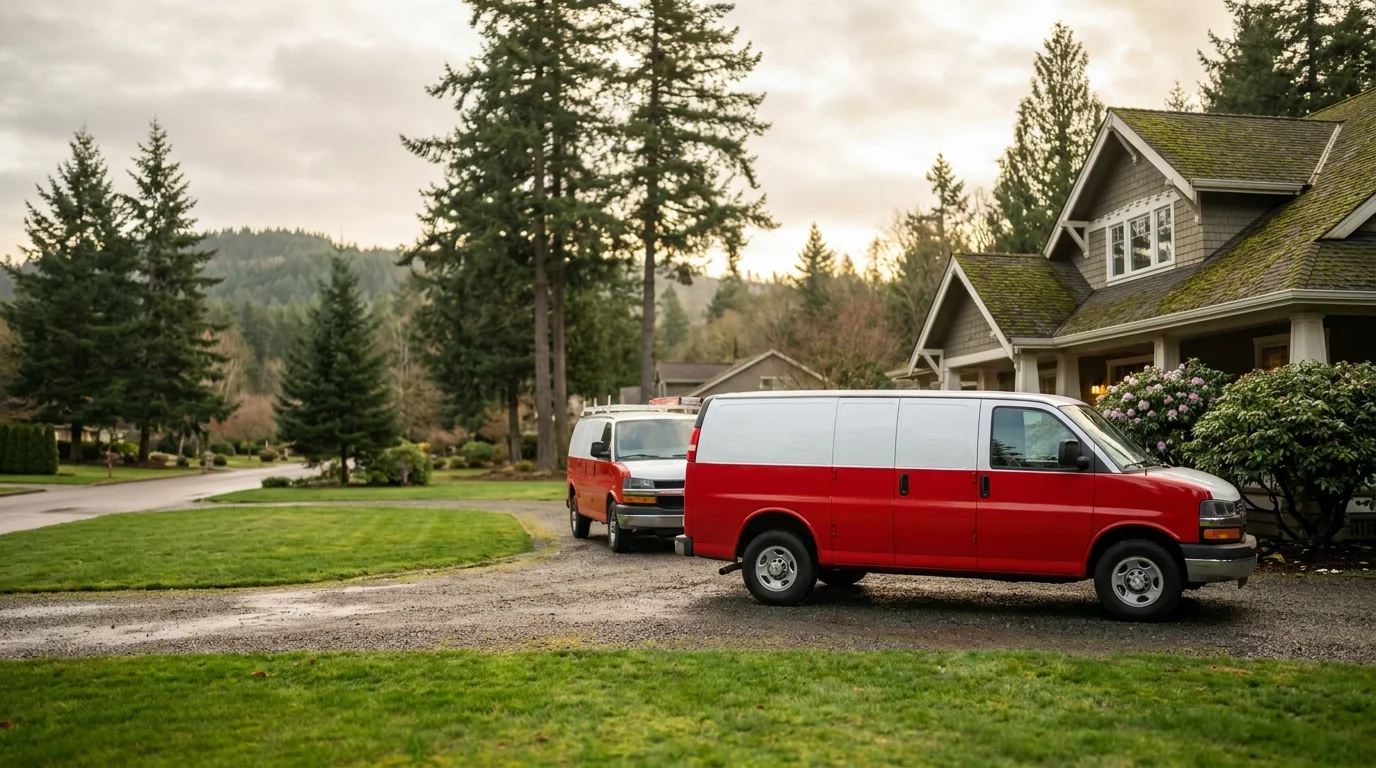
If you’re trying to figure out how to choose a restoration company in Ashland, the short version is this: verify their certifications before you verify their price. Ask who documents the loss for your insurance claim, how they measure moisture (not just “it feels dry”), and whether the person on your phone call is the person who shows up. A legitimate water, fire, or mold company will answer those questions without hesitating. A truck-and-vacuum operation will steer you back to the estimate.
Ashland’s older housing stock, especially the Craftsman and early-20th-century homes near downtown and the Railroad District, makes this decision higher-stakes than it looks. Plaster walls, galvanized plumbing, and hillside lots with limited crawlspace access all change how a water or fire loss behaves and how it needs to be handled. Picking the wrong contractor here doesn’t just cost money, it can mean mold growing behind a wall that was “dried” with a box fan.
The Situation: Why This Decision Is Riskier Than It Looks
After a pipe bursts, a kitchen fire, or a basement floods, most homeowners are dealing with an insurance adjuster, a damaged home, and a list of contractors who showed up on a Google search within hours of the loss. Some of those companies are IICRC-certified firms with trained technicians. Others are a van and a wet vac with a restoration-sounding name on the door.
The difference matters because water and fire damage are time-sensitive and technical. Moisture that isn’t fully tracked with a meter can sit inside wall cavities for weeks, feeding mold growth you won’t see until it’s a bigger job. Smoke residue that isn’t cleaned with the right method can re-off-gas odor for months. A company that doesn’t understand the difference between surface-dry and structurally dry can hand you back a house that looks fine and isn’t.
Questions That Separate a Real Restoration Company From a Shop-Vac Operation
Before you sign anything, ask:
- What certifications does your technician hold, specifically for this type of loss? Water damage should involve someone trained in water restoration (WRT) and structural drying (ASD). Mold work should involve AMRT training. If a company can’t name a certification, that’s your answer.
- Will you document the loss for my insurance company, and how? You want photos, moisture readings, and a written scope of work, not a verbal estimate scribbled on a business card.
- Who actually performs the drying and monitoring? Equipment left running for a few days isn’t a process. Ask how often they’ll return to re-check moisture levels with a meter, not a guess.
- What’s the payment structure? A deposit before any inspection is a red flag. A detailed scope tied to documented damage is normal.
- Do you handle the full scope, or do you sub it out? If mold shows up mid-job on a water loss, do they handle mold remediation themselves or disappear and leave you to find a second contractor?
What Not to Do While You’re Deciding
- Don’t sign a broad assignment-of-benefits form without reading it. Some contracts hand your entire insurance claim over to the contractor, including the right to negotiate with your carrier on your behalf. Read what you’re signing.
- Don’t wait more than a day or two to get someone out for an active water loss. Standing water and wet drywall start supporting mold growth within 24 to 48 hours in the right conditions. The decision paralysis costs you more than a quick phone call would.
- Don’t assume the cheapest bid is the safest bid. A lowball estimate on a fire or water job usually means shortcuts: incomplete demolition, undersized drying equipment, or skipped moisture checks behind cabinetry and baseboards.
- Don’t let anyone talk you out of calling your insurance company first, even if the contractor says they’ll “handle everything.” You should know your coverage and deductible before work starts.
When to Call a Professional vs. Handle It Yourself
Some situations are genuinely manageable without a restoration company: a small, contained spill that’s mopped up within the hour, or light surface soot from a candle that never touched drywall. Wipe it down, dry it out, keep an eye on it.
Call a professional when:
- Water has been sitting for more than a few hours, has reached subfloor or drywall, or came from a source you can’t fully identify (a slow leak behind a wall shows up as a soft spot, a faint musty smell, or a water stain that keeps reappearing after you wipe it).
- A fire, even a small one, involved synthetic materials (furniture, electronics, cabinetry), since the smoke residue penetrates differently than wood-smoke soot and needs specific cleaning agents.
- You can smell mold, but can’t find the source. Smell without a visible source usually means it’s inside a wall, under flooring, or above a ceiling, which calls for mold inspection and testing rather than guesswork with bleach.
- The loss involves a basement, since Ashland’s hillside terrain means groundwater and drainage issues behave differently from one block to the next, and a flooded basement rarely dries evenly without equipment.
What the Recovery Process Should Actually Look Like
A properly run job follows a sequence, not a single visit. Expect:
- Inspection and documentation. Moisture mapping with a meter, photos of affected materials, and a written scope before demolition starts.
- Mitigation. Water extraction, controlled demolition of materials that can’t be dried (soaked drywall, swollen baseboards), and fire/smoke cleaning using methods matched to the residue type, following standards like the IICRC S500 for water and S700 for fire.
- Drying and monitoring. Equipment placed based on the moisture readings, with daily or near-daily checks until materials read dry, not just until the visible water is gone.
- Verification. A final moisture check confirming the structure is dry before any rebuild work begins.
- Reconstruction, if drywall, flooring, or cabinetry had to come out.
If a contractor skips straight from “we pulled out the wet carpet” to “you’re all set,” ask what the moisture readings showed before they left.
If you’re in the middle of a water, fire, or mold situation in Ashland right now and trying to sort a legitimate restoration company from a guy with a van, Swept Away Restoration can walk through what we’d document, test, and dry before any work starts. Call (541) 821-3664 to ask questions first, before you sign anything.